Voices in the Dark is done! It is publishing now across ebook retail sites. Be sure to check out https://melanienilles.com/books/voices-in-the-dark/ for links to be updated as it shows up in various stores.
Sunday, January 2, 2022
Happy Book Day!
Tuesday, December 14, 2021
Forgotten Worlds format explanation
I have been wondering for some time if some readers may have an issue with some of the formatting styles chosen for the Starfire Angels: Forgotten Worlds books. So, I thought I might make a quick post to explain some of the styles used for those who aren't certain or who believe those might be errors.
LANGUAGE
First off, because this series is multi-cultural and that involves many made-up languages, I had to find a way to designate when characters are speaking a different language, besides always saying it with every dialogue line. That could get very annoying.
Since the primary language is Standard (pretty cliche with science fiction), short for Standard Galactic Trading Language, I don't do anything special for that. That's your basic "English" language for the characters, because I'm an English-speaking author. However, if I had this translated into another language, Standard would be that language. You get the picture.
Second, in my Starfire Angels books, I have always used square brackets for the Inari language translation [], so I kept that.
Then, I added Ru'owa, the Feri language, so I had to designate that a different way, so I chose the fancy brackets or braces {}.
If I use a third language or don't use Inari, I may use the square brackets in that particular book but will state what language it is. Or I may use a different way to designate that language translation.
In general...
[] = Inari language dialogue
{} = Feri Ru'owa language dialogue
TELEPATHY AND THOUGHTS
This was a little tricky. Traditionally, thoughts were always put in italics and so was telepathy. I've also used quotes around telepathy to designate speech. However, since Nya isn't telepathic but her thoughts can be heard by telepaths and sometimes telepaths can block their thoughts, I felt that it was important to differentiate in a new way.
What I did was only put quotes around non-POV thoughts that the POV character can hear. All POV character thoughts are quote-less. This can also be helpful, if you see the pattern, to know from whose perspective a scene should be seen. Sometimes it gets a bit hazy when there aren't any or are few thoughts or a character is observing another only from the outside.
OTHER ITALICS USED
I also used italics for some non-Standard (aka alien) words and also for ship names. This helps you see that sometimes a word isn't translated in [] or {} dialogue or that a word is actually a ship name and not a word, besides being capitalized.
Another way I use italics in the series is with dreams or Starfire visions, to differentiate dreams or memories from the present or reality.
If I think of any other formatting styles I've used not mentioned here or someone leaves a question, I will edit this post. Otherwise, I hope this helps alleviate any confusion.
Monday, November 29, 2021
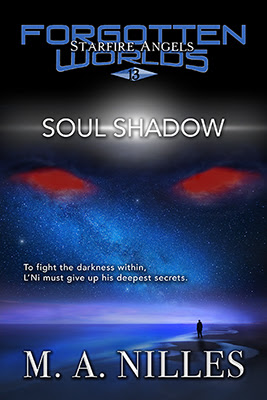
SOUL SHADOW News and Cover!
It's done! The first draft of Book 13 of Starfire Angels: Forgotten Worlds is complete at just over 49,000 words. Up next--editing.
And I have a cover for Book 13. I think this conveys the internal struggle of the story about something dark and sinister. The story involves L'Ni's memories, so there's plenty of science fiction to it, but a space station or space battle might give the wrong impression of this particular story.
The plot isn't this series's typical action type of story but something more dramatic, personal, and of an internal conflict nature, which is why it's difficult to fight for such a warrior as L'Ni--the battle is taking place completely within him. (He can't fight it with his hands or weapons.) He's defied its rule, and now the creature he once called a god has found a way to attack him from within, since it can't yet breach the barrier between dimensions. It essentially is a demon.
I just hope this cover is intriguing enough for the series.
ps - The blurb was harder to write than the cover was to design, and I may still tweak it before publication.
Wednesday, November 10, 2021
music suggestions for Forgotten Worlds
I've never applied it as a reader of any particular book, but as an author, music definitely has an influence on me. There's something about music that inspires, whether it's a deep, thumping bass; a lively jig; a dramatic score; something discordant and creepy; or soft and gentle. Music can affect ones emotions and inspire ideas. Its affects are well documented in studies.
As a writer, I often hear a song that connects with a particular scene or character. It has a power all its own on my creativity, igniting a focus that I can't escape.All of my books have at some point had songs or scores that hit the right note (pun intended) with a scene or character.
In my latest series, Starfire Angels: Forgotten Worlds, I've found some scores along the way that kept me going, but when it came to Book 10: DRAGON AND FURY, there have been two now that really struck me. Initially, Shadowlands by Revolt Music Productions struck me as the combat games entrance of each titular fighter, the Black Dragon and the Fury.
I can't help but to picture their entrance, the pause before the fight starts, and then the beginning of their fight. It first struck me at some point while writing the book. I could see it for other possibilities too.
And then, after releasing the book, I was struck by Undefeated by Skillet.
Friday, October 1, 2021
Now Available - DRAGON AND FURY
It is done! DRAGON AND FURY is finished and published as of last night. It will take time to appear at all the online ebook retailers but is already at the major bookstores (links below image).
Apple: https://books.apple.com/us/book/dragon-and-fury/id1588334813
Barnes and Noble: https://www.barnesandnoble.com/w/dragon-and-fury-m-a-nilles/1140238141;jsessionid=0F4533BE2A02190A7B55C54290583ED2.prodny_store02-atgap08?ean=2940165675799
Kobo: https://www.kobo.com/us/en/ebook/dragon-and-fury
Smashwords: https://www.smashwords.com/books/view/1107325
Saturday, September 11, 2021
the bane of a long series
I just realized the addiction that all sff writers must have, which I am calling MSUAIG (Making Stuff Up As I Go, although the "S" could be a certain 4-letter word). I have spent this morning checking through the previous 9 books of the Forgotten Worlds series and realizing how much I didn't add to my series wiki (aka series bible) that I should have in there for when I have questions. I have also realized that I need to break it into some new categories because it has grown to be too much for simple alphabetizing. I knew this would happen but not to this degree.
Fictional worlds with your own made up stuff can get tangled with details of other fictional worlds we've enjoyed, and keeping that straight is like untangling delicate necklaces that were thrown into a box and shook up. (If you've ever experienced that, you know what a frustration it is to untangle.) It's also why I can't read much of other books or watch much television other than news/nonfiction when I'm in a project like this. I can only do that when I'm taking a break or it gets jumbled.
At some point, the MSUAIG catches up and I have too much stuff to manage easily. I need to make the time to organize it better now that it's grown so enormous. I only have half this series written and it's already a monster to manage. I hope that I can keep everything consistent, which was why I was checking through the past books. There are some small formatting inconsistencies, but nothing major, at least nothing major that jumped out at me. That's also why I make notes about certain details that don't fit neatly into any category.
Nevertheless, I am doing my best to stay on top of those details. I am a stickler for it, but I am nowhere near perfect. I would need a photographic memory to keep track of everything perfectly all the time. Since I don't have a perfect memory, I'll just have to keep making time to skim back over the series before I finish new books. This is partly why each new book is taking longer to finish...because I worry about details.
I am constantly worrying about names of people and places and numbers--did I already mention Nik's siblings besides Tatiana (Tia)? Did I mention previously how long Ann was captain or how long Simms was her first officer? I also worry about uniforms and descriptions and sayings--What expression would a Paxon use for frustration? (that I can remember pretty easily--Cursed Issan!)... and that's just a drop in the bucket of details I worry about.
You get the idea. Details like these are difficult to keep on track, but there are many minor details that worry me, perhaps even more so because they more easily slip by.
I am working hard on the final edits of Book 10 in the hopes of publishing later this month. This is but a small part of the editing process, and usually after I've managed the major factors of the story. However, it is very important to me to the point that, if you find any inconsistencies, please contact me. There may be a logical reason for something seeming to be inconsistent, but it could also be that no one else caught the mistake.
Thursday, August 26, 2021
unraveling the explanations opens opportunities
I have a lot of fun figuring out the logical side of explaining my fictional worlds. I leave so much out of my books, although I try to offer some minimal explanations to at least give the reader a better understanding of what things are. That's the trick of making up science fiction and fantasy worlds--keeping the science/magic plausible, whether that involves ecosystems, governments, magic systems, or even the technology of a starship. The balancing act is not boring the readers.
I was just thinking about something today. I had already figured out how the shield systems worked on the starships and the limitations of those systems, but I hadn't quite unraveled how Vel and Shen are able to recalibrate the shields of the Iludrin to withstand more than their standard limitations. In THE DESTRUCTION OF WALLS, I came up with a way for them to hold out against the Issan, but I let the technical explanation go without too much thinking. I had a vague idea and didn't get into any great detail.
In book 12, they're at it again with shield systems. Again, I hadn't given it much consideration how. I just knew that these two--a skilled mechanic and an educated engineer (and expert in inter-dimensional physics)--would make it happen since they had already come up with the method in book 5.
Today, exactly how that worked opened to me. It was there but never fully realized until now. Learning this reminds me of how excited I was when I came up with the whole ecosystem of Inar'Ahben back when I was writing STARFIRE ANGELS, the very first book of the Starfire Angels series (or, rather, when I was writing its predecessor, which was rewritten into SA). Follow the logic and the answers will reveal themselves. It all makes perfect sense to me.
Now, I know exactly what Vel and Shen are doing. It's pretty detailed and I may use it one day if Vel ever feels like divulging that in thoughts or dialogue, but for now, It's a nice chunk of page in my growing Forgotten Worlds wiki file. Someday, I may reveal that too, but for now, it's my series bible with everything I need to know about characters, species, worlds, technology, ships, history, militaries, events, and even synopses for the books to come, as well as other details and clips from what is already written. (I'm always updating it.)
With half the series now written, it's a lot of detail to track and the document is only going to grow. (48 pages total with 29 pages of detailed references of this universe, and counting. The other pages are the synopses of books to come, some rather lengthy, or ideas not fully developed.)
I now have a deeper understanding of how shield systems work in my FW universe, one more logical explanation so that I can keep the tech consistent throughout the series. And I may use what I've developed to create another problem for the characters at some point. (Cue the maniacal laughter of a writer enjoying the creation of difficulties for their characters.)
The better that you can logically explain things, the more plausible the situations of the characters in that setting will be. Also, you'll have far more tools at your disposal to create challenges for your characters to overcome, and isn't that the fun of reading--to cheer on your favorite characters to success over whatever challenges or conflicts they face?
I now have a better understanding of what can go wrong when shield systems are tampered with, and that is giving me ideas... 😈
Wednesday, August 18, 2021
Forgotten Worlds Book 12 ... DONE!
It is done, or at least the first draft is done. The first draft of Book 12 of Starfire Angels: Forgotten Worlds is done around 45,000 words.
Technically it's not done done, but it was only a few lines from done when I decided to change a detail about the final battle which would eliminate the final scene I was writing. I had an idea while walking (walking, showering, or driving--always the times when those "Aha!" moments hit). I realized that I had introduced something early on that was not fully utilized.
It was brilliant! I had introduced a piece of the puzzle without realizing it. I love when that happens.
As L'Ni tells Nya, "Use everything."
The best part is that this book means that I'm about halfway done with the entire series. I expect it to be 24-25 books. I keep getting inspired with more ideas, but I don't want to stretch it out too much. It is so much fun to write, though!
Now, I need to rewrite that space battle scene and figure out a new final scene. Then I get to read through and rewrite and add in whatever else I feel the story needs.
----------
Only then will I go on to finish editing Book 10 for a September release. Watch for more to come on DRAGON AND FURY!
Sunday, May 30, 2021
FERIOUS publication!
It's done! The wait is over! FERIOUS has been uploaded and is disseminating to retailers as you read this. What a furious pace in editing! This one was a killer for me to edit--so many complications in this one. However, after initially thinking I was done yesterday and accidentally posting this announcement before I was ready, I can now announce that Book 9 of the Starfire Angels: Forgotten World series is definitely ready for your reading enjoyment. (Now, I'm on to writing book 12.)
Sunday, May 16, 2021
Writing mechanics 101
I was chatting with someone new to writing recently and it got me thinking about some of the best writing advice I've learned over the years, especially when it comes to science fiction and fantasy. This person had already mastered most of the grammar and word choice issues (active vs. passive tense verbs) and sentence structure.
Too many writers who have never hired an editor write stiffly, mechanically, and passively. It's cringey (at least to me). It's why I gave up on critique sites--too many beginners with good ideas who don't know how to manifest those ideas into readable text. The best way to write well is to read good writing. Critiquing bad writing is like only breaking colts--until you work on the refinement of writing (training), you will never be a truly good writer (rider). I learned that in my writing and by training intensely in dressage in my riding. (Top riders ride all level of horses, because the upper levels keep their refined skills sharp and their skills bring up green horses the right way; versus those who only start horses and never get to practice and feel the very subtle and delicate balance of more advanced horses.)
The lesson there is: hire a professional editor, at least a few times, so that you can learn what you don't know, especially about your own writing. If you can learn to self-edit, that's great, but having someone else at least get you going down the road to better writing puts you many steps ahead in your skills (like I did with hiring an editor early in my writing career who made a huge difference in teaching me better writing that critique amateurs weren't helping me learn, and then again with dressage in regular lessons to teach me what I needed to do to improve my skills training my horse beyond the basics).
One thing that my early hiring of a professional editor taught me is to use all the senses, where they apply anyway. (That poor editor suffered through my awful early writing, bless her heart.) It adds color to a scene to experience more than what you see happening. Try writing a scene in the dark as a test. Our other senses are enhanced when we can't rely on what we see. With your characters, you'll have to think about what they experience in their other senses when they can't see. This is a good way to get into practice. Or write about a meal setting. Whatever it takes to get into practice and start thinking about all the other senses beyond sight will help you begin to help your characters experience the world more fully and immerse your readers.
However, don't use sense verbs (feel, hear, see, smell, taste) but describe something in a way that stands out. Instead of saying something like "She felt cold." try "The cold bit down to her bones."
That leads me to the next point in enhancing your writing. The most basic advice is to write in an active voice as much as possible and minimize the passive voice. Initially, newbie writers will take this to the extreme of NO passive voice, but that's not the case. It should be pretty easy to understand why this is such a big rule, especially in fiction. Active voice adds flavor to the writing and, in close third and first person, can define a character. "The sun burned down upon him." sounds a lot better than "the sun was hot and bright." Passive voice has its place, but use it sparingly. It's dry and dull. Your writing should jump off the page, but too much of that jumping desensitizes the reader for that turn of phrase that should really catch them. That's why I don't condemn passive voice. It has its place. Mix it up, but learn to do it in the right way so that the points that you want to emphasize stand out.
Dialogue is not narrative. Narrative is the author telling the reader what's going on, but dialogue is the character telling the reader indirectly in their conversations with other characters. The writing of dialogue should reflect the character's personality, not the author's. Listen to how people talk. Rarely do we speak in grammatically perfect sentences. We all make mistakes. However, on the page, you want to minimize that. The littlest hint of some of our spoken mistakes is enough to give flavor to a conversation or character.
Dialogue adds layers in other ways, too. Word choice of a particular character can make them stand out. And there are also the pronunciations. In science fiction and fantasy, I sometimes have a species whose language doesn't have certain sounds (the way German doesn't have the "th" sound, for instance) or has certain ways of pronouncing things (like a native French speaker versus a native English speaker--very different when trying to pronounce each other's words).
(Dialogue is so much more, but others have explained it well already. For instance, dialogue can imply or infer to the reader what's happening in action so that less narrative is needed.)
When it comes to setting, the reader only knows what's on the page. That doesn't mean go overboard and put in every single detail, but it does mean, especially in science fiction and fantasy, that you need to explain some things. How you do that without info-dumping is the trick. Sometimes you can't get away from explaining something, but doing it in appropriate places, such as where the character is thinking about it, and keeping it as short as possible, will help move the writing forward. Info-dumping slows the story and can turn off readers. However, not being able to imagine your fantastical world can also turn off readers, because they will be lost. Some things you can get away with implying, especially with readers who have read extensively in the genre. However, never assume all readers will know; any reader could be reading your book as their first foray into your genre. The best way to handle this is to keep it to just one or two sentences where you can when something is introduced for the first time.
On those lines, the same goes for sprinkling in background details or the history necessary to understand some points in a story.
Last of all, everything can be fixed in editing. The more perfect you think your work is, the more work it likely needs in edits. In the beginning stages, you will think you have the next bestseller, but too often that arrogance will blind you to the immensity of flaws. Step back, put it aside, work on something else, and give yourself time away. When you go back to that wonderful story, the veneer will be gone. Stepping out of the story will give you a chance to see it as an outsider would. You'll see it for what it really is. Then, you'll be ready to tackle all the flaws and give it the polish it needs. It's that time and mental distance from a work that will allow you to have the perspective you need to be objective about it.
At some point, you're going to get good at writing and begin to see how far you've come. You'll refine the work in ways you hadn't thought possible. At that point, you want to keep editing and keep refining, because you'll have been humbled into realizing that it could always be better. Know when to quit. Don't over-edit. You can ruin your voice and turn a bright, exciting story dull. No one is perfect.
Writing is an art form. It takes time and practice to become a master of the tools of the trade.